본문
Private Enterprises Can Now Access the Board of Audit and Inspection’s Preliminary Consulting System
- Newsletters
- 2026.08.27
In 2026, the Board of Audit and Inspection (BAI)’s Preliminary Consulting System is at a pivotal moment. In May 2026, eligibility to request preliminary consulting was expanded to include 411 private nonprofit corporations, including industry associations and federations. Applications filed in the first half of the year also rose 2.8-fold year on year, from 34 to 95.
Preliminary consulting has evolved beyond a “protective shield for proactive administration” within the public sector into a practical channel through which private enterprises can address administrative risks in advance, including licensing and permit delays, conflicting statutory interpretations, and regulatory gaps.
This newsletter outlines the system’s key features and recent developments and offers practical guidance on how private companies and public institutions can use it strategically.
1. Background and Overview: What is the System?
2. Key Developments in 2026: Expansion to the Private Sector and Introduction of a Fast-Track Mechanism
3. Representative Cases: Case Studies Published by the BAI in 2026
4. Practical Considerations
1. Background and Overview: What is the System?
The Board of Audit and Inspection (BAI)’s Preliminary Consulting System helps public institutions make proactive decisions when statutory or regulatory uncertainty, a lack of precedent, or concerns about subsequent audit liability make independent decision-making difficult. Under the system, an institution may seek the BAI’s opinion in advance and act accordingly, thereby qualifying for audit immunity.
Initially introduced in December 2018 for 83 entities—primarily central administrative agencies and metropolitan and provincial governments—the system was expanded in April 2022 to include public institutions and local governments, bringing the number of eligible applicants to 651.
Effective May 4, 2026, eligibility was further extended to 411 private nonprofit corporations, including industry associations and federations such as the Korea Chamber of Commerce and Industry (KCCI), the Korea Electrical Contractors Association, and the Korean Society of Environmental Impact Assessment. As a result, the total number of eligible entities increased from 651 to 1,062.
The system is governed by Article 36(2) of the Regulations on the Handling of Audit Affairs of the Board of Audit and Inspection. Under this provision, an entity that handles a matter in accordance with the BAI’s consulting opinion is presumed, absent special circumstances, to satisfy the criteria for audit immunity.
Preliminary consulting may be requested in the following circumstances:
• Where a public institution finds it difficult to make independent determination on an application for a permit, approval, license, or registration;
• Where an ambiguous interpretation of a regulatory statute or regulation makes it difficult to apply it to a specific matter; or
• Where an absence of relevant statutes, regulations, or precedents makes decision-making itself difficult.
The following matters, however, fall outside the scope of preliminary consulting:
(i) matters pending or already finalized in litigation, administrative appeals, criminal investigations, or BAI audits;
(ii) matters seeking to determine the legality or propriety of an administrative disposition already rendered; and
(iii) matters intended merely to resolve a civil complaint or to serve as a means of passive administration or evading responsibility.
2. Key Developments in 2026: Expansion to the Private Sector and Introduction of a Fast-Track Mechanism
A. Expansion of Eligibility to Private Nonprofit Corporations
Following the expansion of eligibility to nonprofit corporations, private enterprises may now access the BAI’s Preliminary Consulting System through their respective industry associations or federations.
For example, when facing delays in permits or licenses, conflicting statutory interpretations, or regulatory gaps, enterprises previously had little choice but to bear the resulting burden or pursue alternatives such as administrative litigation. Now, however, industry associations can consolidate and review regulatory challenges faced by their member companies and submit preliminary consulting requests to the BAI.
This creates a new avenue for addressing licensing and permit delays and legal uncertainty that were previously difficult to resolve.
B. Introduction of a Fast-Track Mechanism and Rapid-Response Teams
To address the growing demand for preliminary consulting, the BAI has introduced the following measures to improve processing speed:
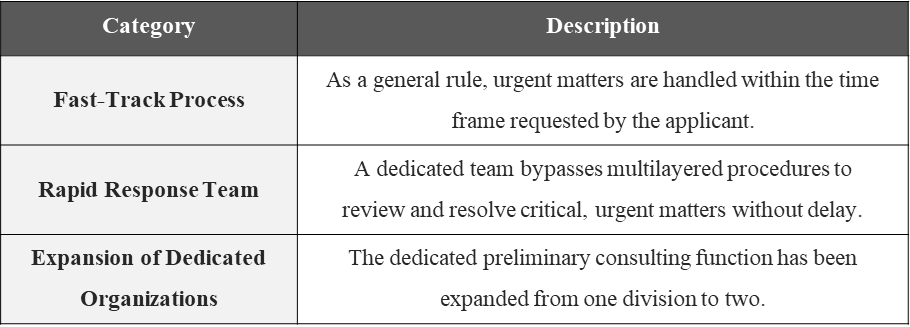
In addition, on August 14, 2026, the Prime Minister and the Chairman of the BAI met to discuss measures to enhance the effectiveness of proactive-administration support mechanisms, reaffirming the government-wide commitment to promoting the Preliminary Consulting System.
The meeting symbolically underscored the BAI’s shift from an audit approach centered on post hoc detection and accountability toward one focused on prevention and problem-solving.
3. Representative Cases: Case Studies Published by the BAI in 2026
A. Licensing and Permits for Integrated Water Supply to a Semiconductor Industrial Complex
This case concerned whether a river occupation permit could be issued for the longitudinal installation of industrial-water pipelines along a national river to supply water to a semiconductor industrial complex, where alternative routes along roads were unavailable because of objections from relevant authorities.
Following a comprehensive review of the detailed criteria for river occupation permits and the views of relevant agencies, the BAI concluded that the permit could be granted, provided that a pipeline installation plan meeting the applicable criteria was established.
The case illustrates how the BAI’s opinion enabled the administrative authority to take the necessary action in light of the project’s public interest and significant impact on the national economy.
B. Joint-Use Permit for Access Roads to Wind Power Complexes
This case involved a developer of a new wind power complex seeking to jointly use an existing national-forest access road serving an adjacent operating wind farm. The key question was whether a joint-use permit could be issued in the absence of an express statutory provision governing such use.
The BAI determined that a permit to use state property is a discretionary administrative act and does not necessarily presuppose exclusive use. In light of the significant forest damage that construction of a separate access road would inevitably cause—approximately 8 hectares and 2,000 pine trees—and the estimated KRW 15 billion in additional construction costs, the BAI concluded that a joint-use permit could be granted.
C. Recommendation on the Final Settlement of Disputes related to Fishery Damage Compensation
In this case, a public institution asked whether audit immunity would apply if, instead of conducting the statutory reinvestigation procedures for fishery damage caused by residual chlorine near the Tongyeong Production Base, it resolved a long-running dispute in full by paying a settlement amount, within the reinvestigation-cost budget, as a community development fund.
The BAI determined that, under Supreme Court precedent, a settlement agreement between the parties remains valid even if it departs from statutory calculation criteria. It further concluded that early resolution through settlement was justified in public interest, given the risk of additional damage from resuming the operation of sodium hypochlorite treatment facilities and the administrative burden caused by the prolonged dispute.
4. Practical Considerations
The BAI’s Preliminary Consulting System has evolved beyond a means of addressing passive administration in the public sector into a key tool for private enterprises managing administrative risk. In light of the recent expansion, private enterprises and public institutions should keep the following practical considerations in mind.
First, enterprises should develop a strategy for using preliminary consulting through industry associations and federations.
Although private enterprises cannot apply directly to the BAI for preliminary consulting, they can achieve substantially similar outcomes through their respective associations and federations.
Companies facing licensing and permit delays or conflicting statutory interpretations in sectors such as development projects, public procurement, public-private partnerships (PPPs), environment and energy, taxes and statutory levies, construction and real estate, and data centers should actively consider using this system.
Second, timing is critical when seeking preliminary consulting.
Preliminary consulting is unavailable where an administrative disposition has already been rendered or an investigation, litigation, or audit is already underway.
Accordingly, when regulatory uncertainty arises before a key administrative step, such as filing a permit application or executing a contract, enterprises should consider seeking consulting before the issue materializes. Securing the BAI’s opinion in advance can offer substantial time and cost advantages over responding to a subsequent dispute or audit.
Third, professional expertise in legal analysis and application drafting dictates the outcome.
The effectiveness of BAI’s preliminary consulting depends significantly on the application strategy and the quality of the application. Accurately identifying the legal issues and systematically presenting the relevant laws, facts, and analysis are critical to increasing the likelihood of a favorable consulting opinion.
Unlike a simple request for statutory interpretation, an application should be logically structured to demonstrate why the proposed course of action is consistent with the principles of proactive administration.
Fourth, post-consulting follow-up should be managed carefully.
Even after the BAI issues its consulting opinion, carrying out the matter in accordance with that opinion is essential to fully securing the benefit of audit immunity. Careful follow-up is necessary to prevent any discrepancy between the BAI’s opinion and the actual implementation.
Yoon & Yang has a team of professionals with extensive experience in preliminary consulting and administrative regulation, including Chang Dong Sohn, a former Commissioner of the Board of Audit and Inspection (BAI) and Senior Advisor who participated in the design and implementation of the BAI’s Proactive Administration Immunity System and Preliminary Consulting System; Won Jung, a Partner and current member of the BAI’s Proactive Administration Support Advisory Committee; and Keun-Ho Kim, a Partner who has directly performed government audit and supervisory duties.
We provide comprehensive legal services throughout the preliminary consulting process, including developing application strategies, preparing applications and legal opinions, assisting with applications through industry associations, advising on implementation after receipt of the BAI’s opinion, and representing clients in post-audit matters, administrative appeals, and administrative litigation.
Please feel free to contact us should you have any inquiries.
- Practice Areas
- #Government, National Assembly & Media Relations